Author guidelines
DeporVida is a national and international scientific electronic journal launched in 2004 from the University of Holguin. Its ISSN is 19-4028. Its mission aims at spreading original articles concerning the areas of Physical Education and Recreation, Sports, Physical and Preventive Culture, and Applied Sciences; likewise, the professional training. Along with these aims and scope, DeporVida massively publishes as part of an issue full-text, in Spanish, English, and Portuguese scholarly contributions. Its articles are original, revision, and reflection works. It is a continuous publication, which means submissions are recieved throughout the year and content will be available as it meets the standards of rigor derived from the reviews and refereeing carried out, as well as the level of originality and ethics throughout the process.
The final audience is teachers, researchers, and the students´ community within the country and abroad, professionals from these areas in general. In addition, all who are interested in increasing their knowledge in this scope of science. It publishes, spreads, and supports the Open Access policy. Consequently, both the journal and every single article have the Creative Commons License Attribution-ShareAlike 4.0 International. Hence, authors do not have to pay to submit their works or redistribute the materials in any format. Papers can be downloaded and stored for free. If authors remix, change or create new materials from the original, they must spread their contributions under the same license.
The following persons make the development of the journal DeporVida possible: editorial staff, scientific board, referees, and reviewers. Only the best contributions are published to achieve the national and worldwide prestige of the academy and professional community.
Reviewers are not part of the Editorial or the Scientific Board of the Journal. They are known as external reviewers.
The selection of the submissions to be published depends on the quality and rigor of the arguments and the validity of the data presented, opportunity and relevance to discuss problems in a research area, originality and topicality, clarity of the language; others like easy to understand writing evidenced in the precision of terms and accurate phrases, comprehension of what it is explained and in the fulfillment of the authors’ ethical criteria, are also considered. Reviewers do not decide whether an article is accepted or not. The general editor decides what to publish. DeporVida only publishes original papers which are not submitted to any other journal simultaneously.
Submission of manuscripts
By submitting an article, the author must certify the originality of the article and that it has not been simultaneously published or sent to any other journal (originality letter).
In that letter must be indicated:
The type of article submitted, as well as the interest area DeporVida accepts.
Attach a brief curriculum vitae in no more than 200 words, written in a paragraph indicating the full name of the author; ORCID is required (in case you do not have one; register and get one through the following link: https://orcid.org), place of work and occupation, email, teaching rank, and scientific category, and the corresponding discipline. Include at the end of the article every person´s contribution, in articles with two or more authors (how everyone contributed with the results’ discussions, and the final version´s approval, mainly).
Likewise, the author will deliver in writing the copyright letter, where he will also declare his agreement with the work and responsibility of all authors, contributors, editors, and reviewers of the Journal DeporVida.
About the submissions accepted to be published
The text must be written in any version of Word, using Times New Roman, font size should be 12, 1.5 line spacing applied, and 2.5 cm margins on all sides. Use Letter page with 21.59 cm x 27.94 cm dimensions. Maxim length of the submission will vary depending on this journal policy section (Consult Policy section). Use the International System of Measures and decimal period (.) as stated by the Spanish Academy within the Spanish Language Spelling (Ortografía de la lengua española) to separate decimals. Insert page number on the right bottom of page, including the first page.
Head submissions with the following information:
Title: in the language of the article, in bold type font size 16. Preferably no longer than 15 words
Authors and affiliation including (2 cm indented to the left):
- Full name (in bold type)
- Teaching rank and scientific category
- Institution
- Region and country
- ORCID code
Abstract: Write it in the language of the article in a single paragraph up to 250 words (Both the abstract and the keywords will be 2 cm indented to the left)
Keywords: They are separated by semicolons and write up to five words. Consult any of the following thesauri:
UNESCO Thesaurus (controlled and structured list of terms for the thematic analysis, document search and publications regarding education, culture, natural, social, and human sciences and communication and information)
https://vocabularies.unesco.org/browser/thesaurus/es/
and the European Thesaurus for Education
https://vocabularyserver.com/tee/es/index.php
Title in English (if the text is in Spanish)
Resumen
Palabras clave
Title in Portuguese
Resumo
Palavras chave
Body of the article (its structure depends on the type of work it is: original, review, or reflection)
Original articles
It is considered the principal publication of a scientific journal and the final product of research. Here are included articles of sports sciences studies (teaching and research related to this topic, physical health, and sports). In addition, those regarding technological innovations. The Journal DeporVida prioritizes this kind of work. They are considered long articles. They have up to 6000 words (do not include the abstract, figures’ captions, and references); no more than six tables or figures, and up to six authors are allowed.
They follow this structure:
Introduction
Methods
Results
Discussion
Conclusions
References
Review articles
Review articles are a detailed, selective, and critical study including essential information in a whole unitary perspective. It is not an original article; however, it is a scientific article that compiles the most relevant information from a particular subject. Its objective is to review the bibliography published and place it within a perspective. It aims at identifying what it is known of the subject, what it has been researched, and what aspects remain unknown.
These works are considered long articles of no more than 5000 words (do not include abstract, figures´ captions, and references), no more than six tables or figures, and up to three authors are allowed. They follow this structure:
Introduction
Methods
Results and discussion
Conclusions
References
Reflection articles
Reflection articles are texts presenting the results of a concluded research from an analytical, interpretative or critical point of view about a specific issue. Hence, this article is subjective as it allows stating reflections, points of view, and the author researcher assessments, derived or maintained from the research findings.
They are short articles of up to 3000 words (do not include abstract, figures´ captions, and references); no more than two tables or figures, and up to three authors are allowed. They follow this structure:
Introduction
Development
Conclusions
References
(For more information consult the Policy section)
Citation guidelines
Deporvida Journal uses APA referencing and citation style as described in the Publication Manual of the American Psychological Association, Seventh Edition. Some general things about APA 7th edition are below:
- For three or more authors, cite only the name of the first author followed by et al. from the first citation.
- Provide the last names and initials up to 20 authors (instead of 7) in the referencing list.
- Include a DOI with the same format as web pages. “DOI” tag is no longer necessary.
- URL addresses are no longer followed by “Retrieved from” unless the date of retrieval is needed.
- APA now suggests the use of different types of fonts. Options include Calibri 11, Arial 11, Lucida Sans Unicode 10, Times New Roman 12, and Georgia 11.
- Unlike the sixth edition, the students’ documents no longer need the short title.
- Levels of titles and subtitles 3, 4, and 5 were updated for better legibility.
- Every quoted work must be included in the referencing list, and every work in the referencing list must be cited within the text (either in a table, figure, footnote or appendix)
Cite in the text
Parenthetical citation: (Sahraei et al., 2019)
Narrative citation: Sahraei et al. (2019)
Information in the referencing list

Direct quotes
Of 40 words or less
Direct quotes of 40 words or less should be enclosed in double quotation marks and should be incorporated into the formal structure of the sentence. No extra format is needed. DO NOT insert ellipsis at the beginning nor at the end, unless the source has them.
Example: Gould and Brown (1991) explained that Darwin used the metaphor of the tree of life "to express the other form of interconnectedness–genealogical rather than ecological” (p. 14).
Direct quotes of more than 40 words
-Do not use “quotation marks”.
-Make the quotation a free-standing indented block of text.
-Begin the citation section in a new line
-Use the Hanging Indent Format with the first line flush to 1.27 cm left margin and the other lines indented.
-If there are additional paragraphs within the citation, at the beginning of each paragraph add the corresponding indentation
-At the end of the citation, reference the consulted source. Include the page number or paragraph. If the citation block begins with a direct quote, at the end of the block you will only need to indicate the page number or paragraph
Example:
Indirect quotes or paraphrases
Use the author-date citation system to attribute paraphrased ideas. It is advisable to indicate the page or paragraph number to help the reader locate the relevant fragment within the reading. It is not mandatory to include the page or paragraph number; it is permitted, though. If the author is part of the sentence after it is mentioned, include the year in parentheses.
Example: Gould and Brown (1991) explained that Darwin used the metaphor of the tree of life "to express the other form of interconnectedness–genealogical rather than ecological” (p. 14).
Referencing
Reference list. It is the list where the full source citation mentioned in the text can be found. It is at the end of the work to help readers find the information of the cited sources. The reference list aims at allowing readers to retrieve and use the sources; therefore, it is necessary to include all the information to locate these materials individually or in the library.
Order of the reference list
This reference list is arranged alphabetically by the author. Place the first author´s last name, followed by the initial of this author´s first name or according to the different variants of the names.
Examples:

How to order different works with the same first author
Entries with a single author are arranged by the year of publication, from the oldest to the most recent one. Examples:

How to order works by corporate (Group) authors
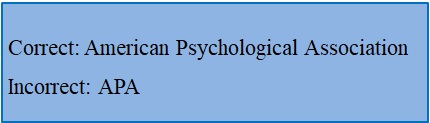
Use the official full name in corporate authors. Examples:
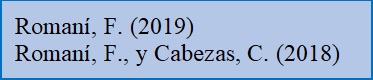
List first entries by a single author, then those by multiple authors. Even though both begin with the same last name, first reference the single author and then when it comes with another one, without considering the year of publication. Examples:
References with the same author and the same date of publication are arranged alphabetically by the title (except articles a, an, the). Examples:

Whenever there is no author, start with the title and arrange it alphabetically by the first significant word in the title. Example:

Reference elements
*Authors
Two or more authors (up to 20 authors). Include them all. If an article has 21 authors or more, list the first 19 authors, then insert an ellipsis (…) and then the last name and first initials of the last author.
Example:
Publication date
- Write in parentheses the year indicating when the work was published. Example: (2013)
-For journals, reports, newspapers include (month or year and day). Example:
If the date is unknown, use n.d (for no date) in parenthesis. Example:
Title
Article or chapter title: capitalize only the first letter of the title and use period at the end. Example:
** Periodicals

Monograph

Newspaper article. Example:
Cieply, M. (2013, November 11). Gun violence in American movies is rising, study finds. New York Times.
Newspaper article, On line
Harding, E. (2019, November 21). Invercargill Kmart ready to open.The Southland Times.https://www.stuff.co.nz/national/117596378/invercargill-kmart-ready-to-open
** Books, reference books and book chapters
For a whole book follow this format. Examples:

Book chapter. Examples:

** Doctoral dissertations, master´s thesis and degree thesis
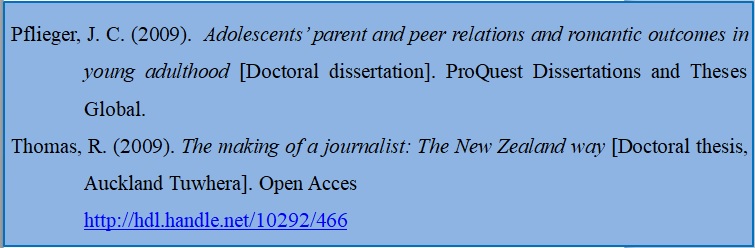
**Congress, symposium, lecture, seminar
Acts published in books. Example:

Acts often published on line. Example:

Research articles presented in congresses and symposiums. Example:

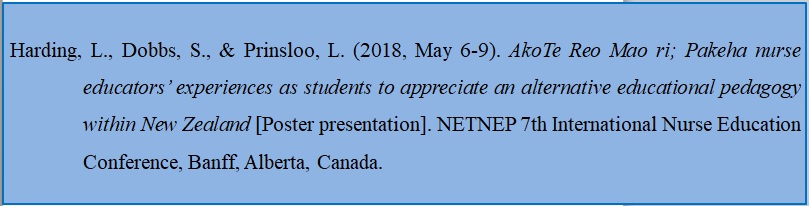
Poster. Example:
Audiovisual media
You tube video. Example:


Graphic media
PowerPoint slides. Example:


**Social media publications
Facebook examples:

**Webpages
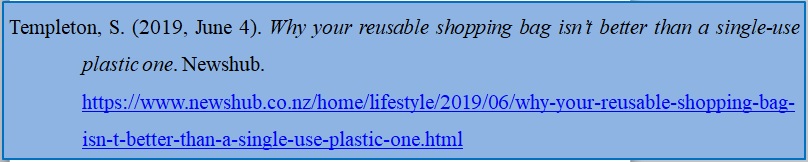
Webpage on website (news and similar). Example:
**Tables and figures
* Tables. Components
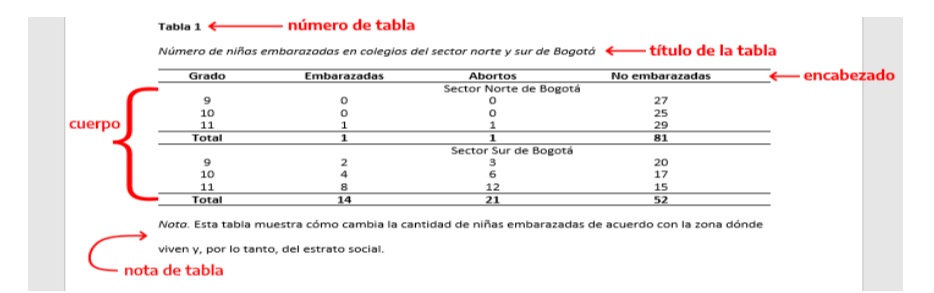
Tables in APA style have the following basic components:
Number: the number of the table (for example, Table 1) is the first thing that appears. Write in bold. Number the tables sequentially according to their order in the research.
Title: write the title of the table in a line using double spacing. Tables should be labeled above the table and below its number. The title must be short and descriptive. Capitalize and use italics.
Headings: tables include a variety of headings according to their nature and the way data is arranged. They all have column headings. Justify them all.
Body: It includes all the rows and columns within a table (including the headings). Use 1.5 spacing or double. It is recommended to justify the text in each cell of the table. However, if aligning text left increases, do it.
Note: use notes to clarify the contents of the table for readers. Use them in cases the table cannot be understood by reading the title or the data themselves. If you use abbreviations in the table, you may specify them in the notes. You can also use them for copyright attribution, further explanations with asterisks. It is not obligatory; therefore, they must be meaningful and have a purpose. Do not include notes unless they are necessary.
Table borders: In general, tables use top and bottom borders below the column headings and above the totals in the column. Do not use vertical lines to separate data, and do not use lines around each cell in a table.
Font Face and size and spacing: Use the more effective spacing regarding the table design to make the information easy to understand. Use double spacing for the number of the table, title, and notes. Use the same face and font size in tables as in the whole text.
Location of the tables: there are two options to locate the tables (and figures) within a research. The first one has to do with inserting tables in the text after it is mentioned for the first time; the second one, insert every table in different pages after the referencing list.
If the table is short, combine both the text and the table on the same page. Insert the table at the beginning or the end of the page. You may consider that a table can take up the whole page with no problem. You may insert a blank line between the table and the text to improve the visual presentation.
Long or wide tables: if by any chance a table is larger than the page, repeat the headline on the second page and the next pages (as many times as needed). If it is too wide to fit the page, use the horizontal orientation of the page with the wide table.
How to write the table title:every table will have a short, clear, and explanatory title. It should be easy to understand what information is in the table from its title.
How to cite table in the text: when citing a table or a figure in the text consider doing so by its number, for example: “Table 3” or “Figure 2”. Do not refer to the table by its position regarding the text (for example: “the following figure”) or its page number (for example: “the table in page 12”).
* Figures
Figures (images, graphs, photos, or maps) will be high-definition images, and you must save them in the .jpg extension. Likewise, reference them within the text. The font and the title will be edited. All visual types of elements different from tables are figures in the APA style. For example, illustrations, computer graphs, photos, lines or bar graphs, bar charts, drawings, maps, etc. Tables and figures have the same general settings.
Components of a figure
Figures in the APA style comply with the following components
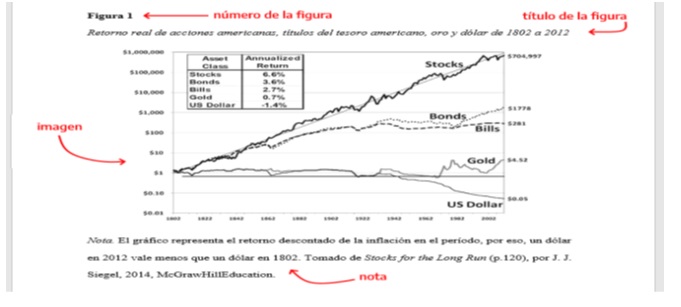
The number of the figure: It is the first item to add (for example, Figure 1). Use bold type letter. Number figures sequentially, e.g., Figure 1, Figure 2
Title: the title of the figure will appear in a line below its number. It should be brief and explanatory. Capitalize it and use italics.
Image: insert a graph, photo, drawing, or any other illustration.
Caption: a figure´s caption must be placed along its bottom to explain symbols used in the image of the figure. It should be concise but descriptive.
Note: if the image is hard to understand by itself or the title, add a description. (for example, definitions of abbreviations, copyright attribution). Include notes of figures only as needed.
Location of the figures in the text: there are two options for locating the figures (tables) in research. Include figures in the text after you mention them for the first time; add every figure on a different page after the referencing list or after the tables (if there are any).
How to cite a figure within the text: images may appear embedded in the text or at the end in a list of figures. If you embed them within the text, you must reference them right after you include them. It means you first comment on the image by its number, and then embed the figure into the text.
Example:
We always suggest you to consult the source of the Publication Manual of the American Psychological Association (APA). Follow this link: https://apastyle.apa.org/
About the assessment and publication process
Submitting is the first step; the manuscript must comply with the journal´s policies (types of articles, structure, extension, referencing guidelines). Receiving a work does not imply under any circumstances that it is accepted by the Journal DeporVida. The General Editor may directly reject works submitted without consulting an external reviewer if manuscripts are considered inappropriate for the journal and lack the demanded quality level, do not fit the scientific objectives, or because it presents evidence of scientific plagiarism.
At this level, if the article passed, then goes to the double-blind peer review process, lasting up to a month to deliver a report. Double-blind peer review is the method used to assess the articles, which searches for a quality backup from two external reviewers with the comprehensive objective of improving the works’ demands. Reviewers are experts acknowledged in the field in question as they state their colleagues’ works. Anonymity is fundamental among the participants; it means reviewers and authors do not know each other.At the end of the perusal, reviewers indicate whether the article can be published the way it is, if it should be modified or not, or if it is rejected.
In case that one of the reviewers considers the work must not be published, then, it will be evaluated by a third reviewer, whose final report will help solve the contradiction and take a final decision in agreement with the general editor. If another conflict arises between these persons, it will be the general editor´s responsibility to decide one way or another.
If the article´s report suggests some changes the author will be responsible for making them within a month (period established by the journal). Once the author resends the work with the suggestions accomplished, they will be checked again; and if needed, it will be returned to the author once more, until the document is finally correct. If the requirements are not fulfilled, the article is not published. In these cases, the acceptance date will be set from the very moment the final version was approved. Articles will be published as they satisfactorily fulfill the editorial process; so, they can be consulted in subsequent issues.
Anti-plagiarism policy
DeporVida has the Plagiarism Detector for students and professors. Copyscape and Turnitin alternative to detect plagiarism.
Privacy statement
Persons participating in researches as a part of the sample have the right to remain in secret; a situation which will not vary without their express consent. In this regard, the identifiable information non-essential will be omitted. If any doubt regarding the anonymity state remains, informed consent must be registered. Once there is informed consent it will be indicated in the article.